
The growing need for brand marketing in the age of AI, with Nick Gaudio
September 21, 2026
Nick Gaudio has spent about 15 years making a living from the written word. It started with teaching, then running a newspaper, and now marketing tech brands. In conversation with Daryl Pereira and Kayley Smith for Business Schooled, he makes the case for the growing importance of crafting a brand personality in the age of AI.
How brand wins in competitive markets
As many marketers know, fighting for brand can be a tough fight inside a business with pressure on immediate pipeline and marketing dollars. Nick’s most useful argument internally is that transactional marketing is expensive forever. You win someone, they forget you, they go back to the search bar, and you pay to win the next customer to fill the gap. Brand is the thing that makes people remember you, and the thing that can make them stay.
He saw it at Rev, the transcription company that initially didn’t stand out in a crowded, commoditized market. Without brand recognition there was no brand loyalty, which directly impacted customer retention metrics. Nick took control of product-team customer mailings, creating a voicey, human, and community-oriented newsletter. The work helped turn a transactional customer touchpoint into something people actually wanted to read. Marketers started calling out the marketing on social media, bringing more business in. That is brand as a flywheel, not a campaign.
He frames the craft as friction and freight. Friction is the belief you need to change in your audience, whether it relates to the problem or the solution. Freight is the story compressed tight into something memorable. Think tagline, a drumbeat, or a set of actions that match the words.
Human voice is a growing signal
In using AI for marketing, there are major benefits in scaling production and taking on some of the grunt work. Yet to stand out, voice matters more than ever. His practical advice is linguistic. Tell the model to write in E-Prime so it cannot lean on is / was / were and has to reach for snappier verbs. Ask for three or four versions at increasing intensity, then pick the one that fits. Most importantly, humanize it.
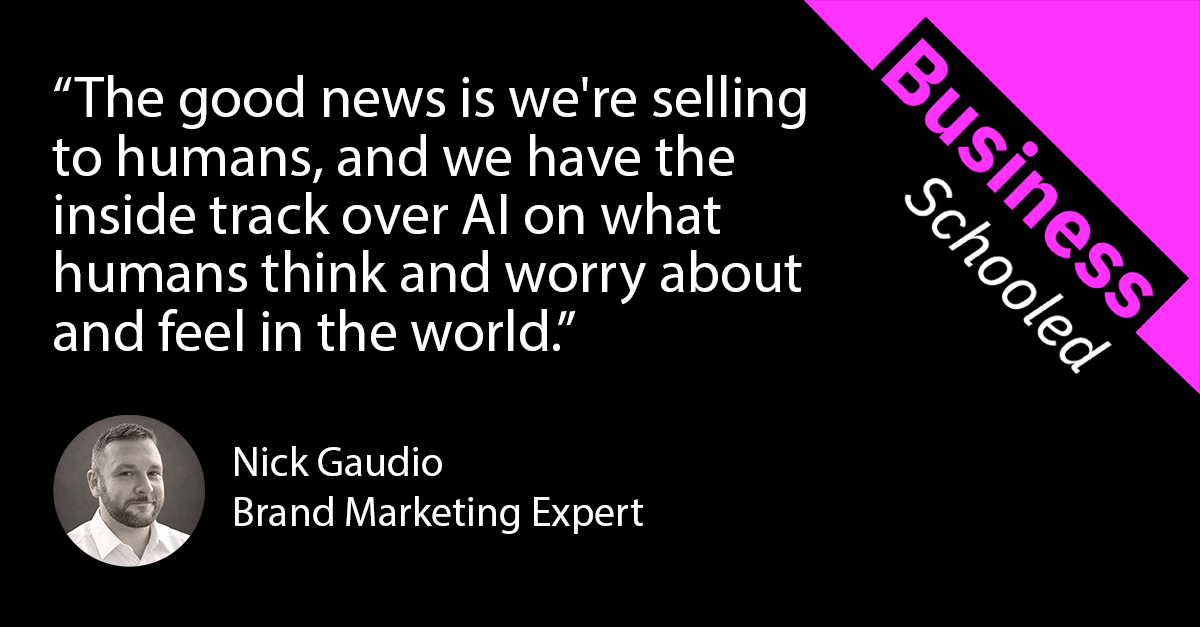
“The good news is we’re selling to humans,” Nick says, “and we have the inside track.” Optimization machines still struggle with being imperfect. Imperfection is where human signals live.
The humanities have an increasing role to play. Take poems as an example. W. H. Auden called poetry “memorable speech.” Nick points out that this is essentially the goal of advertising, too. Both draw from the same toolkit, whether that’s repetition, metonymy, alliteration, simile, etc.
What does the future hold? Nick expects a culling of mediocre talent that cannot show its humanity, as we shift from tactical execution to taste and strategy. Expect to see more human interactions: in online communities, and offline in tradeshows and events, where buyers and customers actually meet face-to-face.
As we continue to use AI for marketing, the aspects that make us more human ironically become more important.