
How NYU's Michelle Greenwald turned 67 types of innovation into an AI tool
November 6, 2026
When generative AI arrived, Michelle Greenwald decided she’d better get up to speed fast. She interviewed 14 people working across advertising, branding and AI ethics, and came away with a conclusion that still shapes her work: “AI can make companies dumber, students dumber as well, or they can make them much smarter.”
Michelle is a professor of marketing at NYU Stern and the founder of Catalyzer, an AI innovation tool. She also spent years as a corporate executive, including as a senior vice president in charge of new product development at Disney. In conversation with Daryl Pereira for Business Schooled, she explains how companies can land on the smarter side of that divide. It’s her second time on the show, following her 2024 episode on innovation and taking the right risks.
From 1,100 examples to an AI tool
Michelle’s approach traces back to a Harvard Business School case about Spanish chef Ferran Adrià, whose innovation checklist pushed his team to take dishes apart, combine opposites and evoke childhood memories. About 10 years ago, she wrote a book that applied the same idea more widely. She gathered 1,100 examples of innovation, many photographed on her travels, and sorted them into 67 types. Each example came with an explanation of why it mattered to a business, such as supporting a premium price or opening up a new market segment.
That book became the database behind Catalyzer. Generic prompts tend to produce generic answers, so the tool gives the AI model stimuli to cross-pollinate ideas across countries and sectors. When a drug company wanted a marketing program for a heart medication, the output drew inspiration from a Louis Vuitton collaboration with artist Yayoi Kusama and something Michelle had seen at a cooking school in Singapore. That gives you a sense of how broad you can think when pushing the boundaries of innovation.
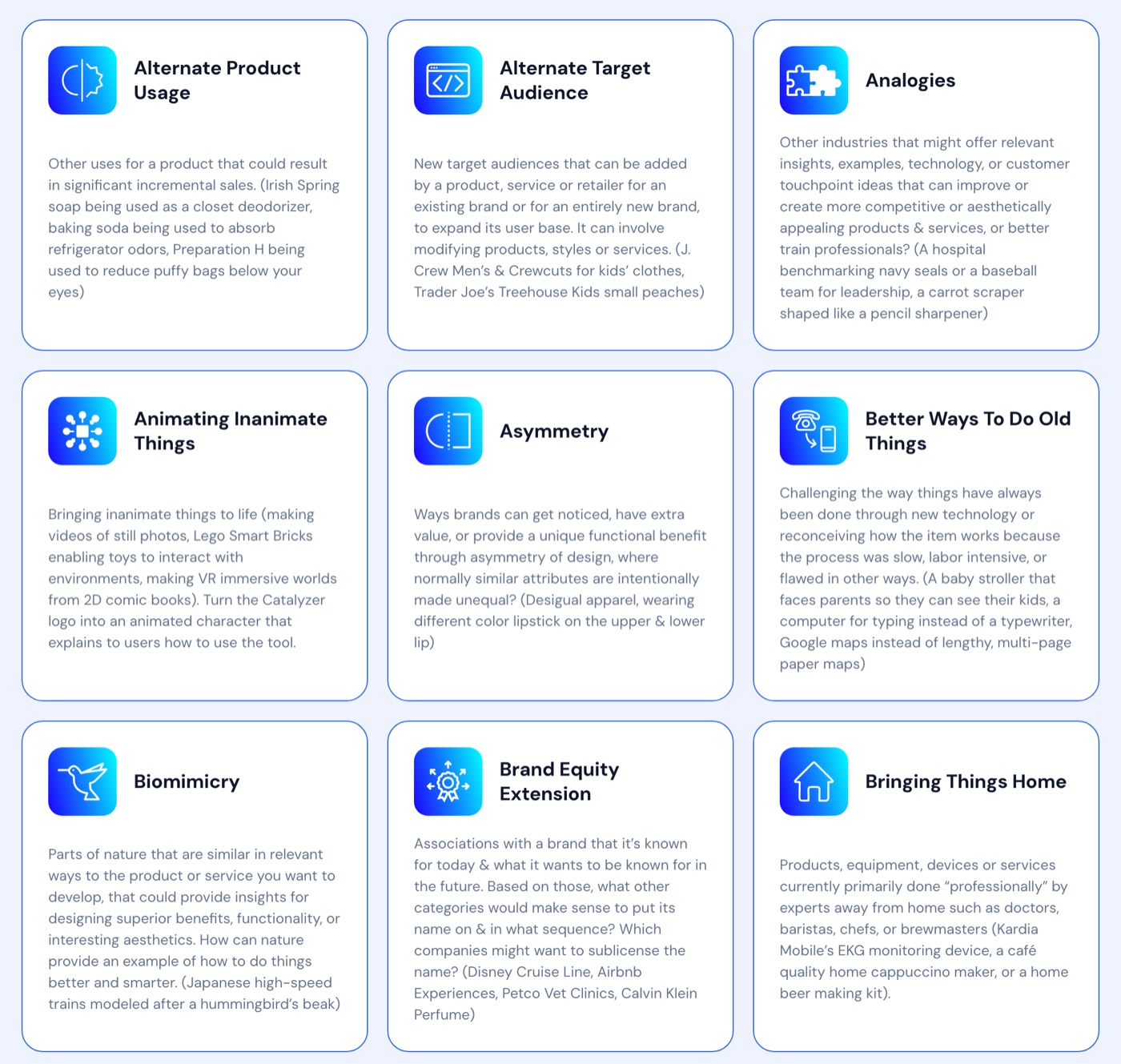
A selection of some of the 67 innovations
Why teams keep having the same ideas
Teams go into a room with a few techniques, Michelle says, and “they tend to come up with the same ideas over and over again.” They lack stimuli, and they don’t push far enough. To make the point, she describes Thomas Edison as a methodical inventor who ran an innovation factory and explored thousands of filament materials. To invent, as he put it, “you need a good imagination and a pile of junk.”
She tests this in class with an identical cup of coffee, asking how many ways it could be priced. The typical answer is one. There are at least nine or ten.
Companies also lock in too early, she says, settling on something obvious because exploring every option is hard. They can overlook customer touch points too. Liquid Death sells water in a can, but hires comedians for its marketing and makes everything from its vending machines to its packaging funny.
Who interprets the output
If everyone asks the same obvious questions, the answers will look much the same. “Where you can differentiate is who is the interpreter of the output and what creativity they bring to it,” Michelle says.
In her workshops, human teams choose the types of innovation they think fit a product, then give Catalyzer the same objective and compare the results side by side. There is some overlap, but much is different, and they can take the best of both.
That kind of rigor takes work. In one pharma exercise, the tool offered 13 strategic directions, and just one of those opened up 12 ways to execute it. Doing AI well, she says, is less about time savings and efficiencies, but more about going deeper and getting richer insights.
Michelle still sees a real opening for people with big ideas. Using Catalyzer’s 32 use cases, someone can move from a customer pain point to features, packaging and a business model in a day, then judge whether the idea is viable. AI can widen the options. Someone still has to choose well.
Learn more about Catalyzer or connect with Michelle Greenwald on LinkedIn.